Updated 20-May-2026
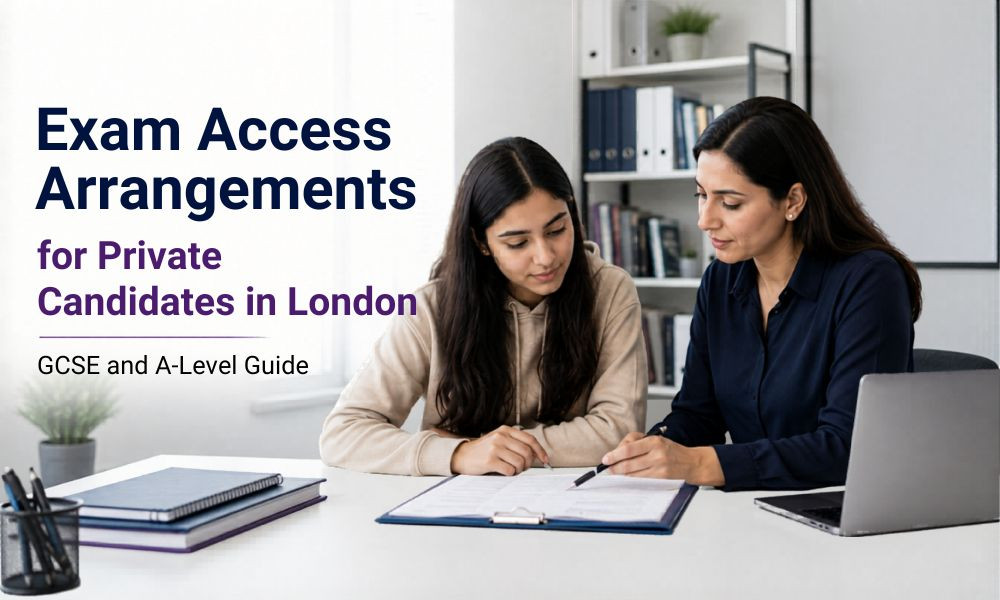
Taking GCSE or A-Level exams as a private candidate can already feel complicated. If you also need access arrangements, it can feel even more stressful. Many candidates are unsure who to contact, what evidence is needed, whether extra time is possible, and how early arrangements must be requested.
Access arrangements are designed to make exams fair for candidates who have a disability, learning difficulty, medical condition, temporary injury or another need that affects how they access assessments. They do not make the exam easier and they do not change the skills being tested. Instead, they help candidates show what they know without being unfairly disadvantaged.
Exam Centre London supports private candidates sitting GCSE, IGCSE, A-Level and other qualifications in London. This guide explains what exam access arrangements are, which arrangements may be available, what evidence may be required and why private candidates should start the process early.
Exam access arrangements are approved adjustments made before an exam so a candidate can access the assessment fairly. They are sometimes called reasonable adjustments, although the exact process depends on the qualification, exam board and JCQ rules.
Common examples include extra time, supervised rest breaks, a reader, a scribe, a word processor, modified papers, enlarged papers, coloured overlays or separate room arrangements. The right arrangement depends on the candidate's normal way of working, evidence of need and the rules for the qualification.
The Joint Council for Qualifications publishes detailed regulations for access arrangements and reasonable adjustments. Candidates and parents can read the official JCQ Access Arrangements and Reasonable Adjustments guidance to understand the wider framework used by centres.
Yes, private candidates may be able to receive access arrangements, but they must discuss this with the exam centre as early as possible. A private candidate is someone who enters for an exam through a centre but is not enrolled as a student there.
Because the candidate is not taught by the centre every day, the centre may need clear evidence before applying for or approving arrangements. This can include previous access arrangement evidence, medical evidence, specialist reports, school or college records, or evidence showing the candidate's normal way of working.
AQA's guidance for private candidates explains that access arrangements for private candidates with a physical disability or learning disability should be requested when making the exam entry and before deadline dates. You can read more on AQA's written exams for private candidates page.
The arrangement needed will depend on the candidate. One student may need extra time because of a learning difficulty. Another may need supervised rest breaks because of a medical condition. A candidate with a temporary injury may need a word processor or scribe for a specific exam series.
Extra time is one of the most commonly discussed arrangements, but it is not automatic. The centre must follow the relevant rules and may need evidence that extra time is the candidate's normal way of working.
Supervised rest breaks may help candidates who need to pause due to fatigue, anxiety, medical needs or concentration difficulties. A reader may be appropriate for some candidates who have difficulty reading independently, while a scribe may be needed where a candidate cannot write or type their answers in the usual way.
Some candidates may use a word processor, but again, this depends on need, evidence and normal way of working. Pearson's student guidance on access arrangements and special consideration gives a useful overview of how access arrangements support candidates while maintaining assessment standards.
One of the most important phrases in access arrangements is "normal way of working". This means the arrangement should reflect how the candidate usually works, not just what they would prefer on exam day.
For example, if a candidate requests a word processor, the centre may need evidence that typing is their usual way of completing written work. If a candidate requests extra time, there may need to be evidence of a learning difficulty, processing difficulty, medical need or another barrier that affects timed assessment.
Private candidates should gather evidence early. Useful evidence may include:
previous approved access arrangements
a Form 8 or other specialist assessment documentation where applicable
medical letters or diagnosis documents
school, college or tutor evidence
examples of normal way of working
evidence from previous mock exams or assessments
The centre will advise what is suitable for the qualification and arrangement requested.
Access arrangements cannot always be arranged at the last minute. Some arrangements require applications before published deadlines, and modified papers often need to be ordered well in advance.
Private candidates should contact the exam centre before or at the time of entry if they think they may need arrangements. Waiting until a few weeks before the exam may make it difficult or impossible to arrange support, especially if evidence is missing or the exam board deadline has passed.
If the issue is a temporary injury or sudden illness, contact the exam centre immediately. The process may be different depending on the situation, and the centre will need to advise what is possible.
Access arrangements and special consideration are not the same. Access arrangements are planned before the exam. They are used where a candidate has an identified need that affects how they access the assessment.
Special consideration is usually requested after an exam when a candidate has been affected by illness, injury, bereavement or another unexpected event at or near the time of the assessment. It does not replace access arrangements and it is not guaranteed to change a result.
If you know you need support before the exam, ask about access arrangements early. If something unexpected happens close to or during the exam, contact the centre as soon as possible to discuss whether special consideration may be relevant.
Before booking, ask clear questions so you understand the process:
Do you accept private candidates who need access arrangements?
What evidence do I need to provide?
What is the deadline for requesting arrangements?
Can you support extra time, rest breaks, reader, scribe or word processor use?
Do you support modified papers?
Will the arrangement apply to all papers or only certain exams?
What should I bring on exam day?
A good exam centre should explain the process clearly and tell you what evidence is needed. If the centre cannot support a particular arrangement, it is better to know early so you can consider other options.
Exam Centre London supports private candidates who need a clear route to sitting exams in London. Candidates can enquire about GCSE, IGCSE, A-Level, Functional Skills and other exams, including any access arrangement needs they may have.
If you need arrangements such as extra time, supervised rest breaks, a reader, scribe, word processor or modified papers, contact the centre as early as possible. The team can explain what information is needed and whether your requested arrangement can be considered for your exam entry.
You can also read Exam Centre London's Private Exam Centre London guide if you need broader information about sitting exams as a private candidate.
If you are a private candidate in London and may need access arrangements, do not leave it until the final weeks before the exam. Start by gathering evidence, checking your qualification requirements and contacting the exam centre before making your entry.
Visit Exam Centre London to enquire about exam entry and discuss your access arrangement needs.
Private candidates may be able to receive extra time if they meet the relevant criteria and provide suitable evidence. The request should be discussed with the exam centre before the deadline.
Evidence may include previous approved arrangements, specialist assessment reports, medical evidence, school or college records, or proof of normal way of working. The exact evidence depends on the arrangement requested.
You should request access arrangements as early as possible, ideally when making your exam entry. Some arrangements have deadlines and may not be possible at short notice.
Access arrangements are planned before an exam to support a candidate's needs. Special consideration is requested after an exam if the candidate was affected by illness, injury or another unexpected event.
Exam Centre London can discuss access arrangement needs with private candidates and advise what information may be required for GCSE, IGCSE, A-Level or other exam entries.
Recent Posts
Categories
Tags